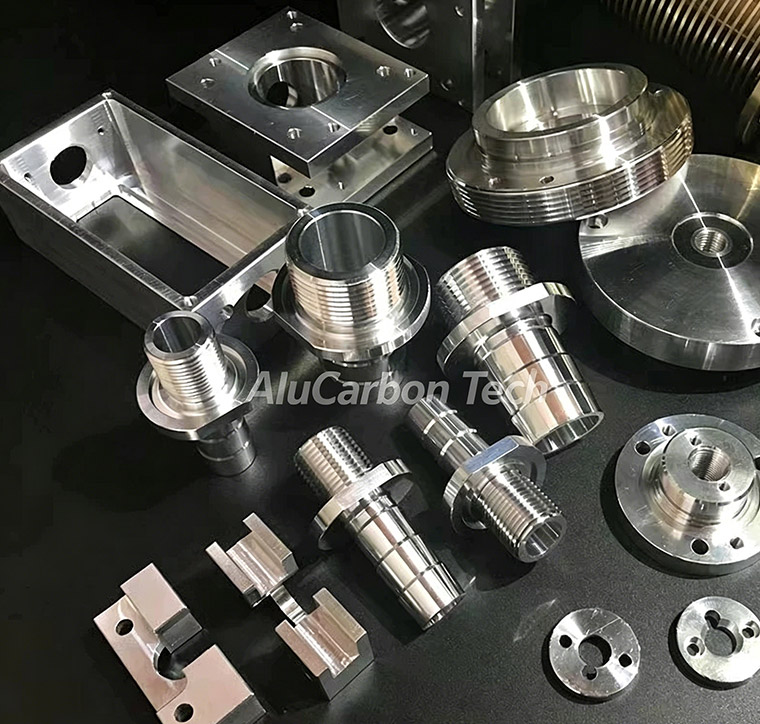
Stainless steel is the material of choice when strength, durability, and corrosion resistance are non-negotiable. Its unique chromium content creates a self-healing passive oxide layer that protects against rust and corrosion even in harsh environments—from saltwater exposure to chemical processing. Used in medical devices, aerospace components, food processing equipment, and industrial machinery, stainless steel delivers reliability under extreme conditions. However, stainless steel is notoriously difficult to machine. Its work-hardening tendency, heat generation, and rapid tool wear demand specialized expertise and precisely controlled machining strategies. AluCarbon Tech brings deep experience machining all major stainless steel grades with consistency, precision, and fast turnaround times for global clients.
Stainless steel alloys are classified by crystalline structure and alloying elements. Selection depends on balancing corrosion resistance, strength, machinability, heat resistance, and cost. Choosing the right grade ensures optimal performance and manufacturing efficiency.
| Grade Type | Key Properties | As melhores aplicações | Usinabilidade |
|---|---|---|---|
| 304 / 304L (Austenitic) |
Most common stainless. Excellent corrosion resistance, non-magnetic, good weldability. 304L is low-carbon variant for better weldability. | Food processing equipment, medical devices, chemical vessels, kitchen equipment, architectural trim | Moderado work hardens during machining, requires careful tool management and generous coolant |
| 316 / 316L (Austenitic) |
Enhanced corrosion resistance vs 304 due to molybdenum. Superior in chloride/salt environments. Excellent weldability (316L). | Marine environments, chemical processing, oil & gas, medical implants, offshore equipment | Desafiador even more work-hardening tendency than 304. Demands tool expertise and high feeds. |
| 303 (Austenitic) |
Excellent machinability (sulfur-enhanced). Free-machining grade. Good corrosion resistance. Non-magnetic. | High-precision fasteners, shaft components, automatic screw machine products, medical instrumentation | Excelente best machinability of all stainless steels. Fastest cycle times, lowest tool wear. |
| 17-4 PH (Martensitic) |
Precipitation-hardening. Extremely high strength (1000+ MPa when heat-treated). Excellent corrosion resistance. Magnetic. | Aerospace fasteners, landing gear, turbine blades, springs, high-load structural components | Desafiador very hard, high cutting forces. Requires carbide tools and slow feeds. Demands expertise. |
| 410 / 416 (Martensitic) |
High hardness after heat treatment. Good wear resistance. Lower corrosion resistance than austenitic grades. | Cutting tools, turbine blades, valves, mechanical seals, high-wear components | Moderado machining difficult in hardened state. Best machined in annealed condition then heat-treated. |
| 2205 Duplex (Duplex) |
Two-phase structure: combines strength of martensitic with corrosion resistance of austenitic. Extremely high strength & toughness. | Severe environmental exposure (offshore, aggressive chemicals), high-pressure applications, extreme temperature | Desafiador high strength means high cutting forces. Work-hardens rapidly. Specialized tooling required. |
Stainless steel's strength and corrosion resistance come at a cost: it's notoriously difficult to machine. Success requires specialized strategies, rigid tooling, and process discipline.
Stainless steel hardens as you machine it, increasing hardness and making subsequent cuts even more difficult. This accelerates tool wear and can cause dimensional variation.
Poor thermal conductivity means cutting heat concentrates at the tool edge, causing rapid tool wear, tool deformation, and potential tool breakage.
Material adhesion on the tool creates a built-up edge that destroys surface finish and accuracy. Requires specific tool geometry and feed rates to prevent.
Combination of hardness and heat means tool life is 30-50% shorter than with aluminum. Frequent tool changes add cost and reduce productivity.
Advanced 3-axis, 4-axis, and 5-axis CNC mills with rigid spindles and optimized tooling for stainless steel. Multi-axis capability allows complex geometries, minimum setups, and superior surface finishes. Ideal for intricate aerospace brackets, medical implants, and industrial housings.
Precision turning centers excel at producing cylindrical components, shafts, and symmetrical features. Stainless steel turning requires rigid tool holders and optimized parameters to minimize work hardening. Perfect for fasteners, valve bodies, and rotational components.
Post-machining surface treatments including passivation (removes iron and contaminants), electropolishing (smooths surface), and electroless nickel plating (adds protective layer). These enhance corrosion resistance beyond the stainless steel baseline.
| Indústria | Componentes principais | Why Stainless Steel |
|---|---|---|
| Medical & Healthcare | Surgical instruments, implants, orthopedic fixtures, sterilizable device components, pharmaceutical equipment | Stainless steel is biocompatible, easily sterilized, corrosion-resistant, and maintains mechanical properties in demanding medical environments |
| Aeroespacial e Defesa | Fasteners, landing gear components, turbine blades, structural brackets, flight-critical hardware | Stainless steel combines high strength with corrosion resistance essential for aircraft, meeting stringent aerospace standards and extreme conditions |
| Marine & Offshore | Valve bodies, pump housings, structural fittings, subsea equipment, chloride-resistant components | Exceptional resistance to saltwater and chloride corrosion makes stainless steel ideal for harsh marine environments |
| Chemical & Food Processing | Process vessels, pump components, tank fittings, food contact equipment, chemical handling hardware | Stainless steel resists corrosion from acids, alkalis, and chemicals while maintaining food-safety standards and easy sterilization |
| Industrial & Power Systems | Heat exchanger tubes, valve components, power plant equipment, pressure vessels, high-temperature housings | Stainless steel's strength, corrosion resistance, and high-temperature capability make it ideal for demanding industrial applications |
Stainless steel's work-hardening tendency makes tolerance control more challenging than aluminum or copper. AluCarbon Tech maintains rigorous quality protocols to ensure consistency despite stainless steel machining complexity:
Stainless steel CNC machining cost is influenced by multiple factors: Stainless steel grade selected (303 most cost-effective to machine; 316, 17-4 PH more expensive), part complexity and geometry (intricate features increase tool changes and time), tolerance requirements (tighter tolerances demand slower feeds and additional inspection), production volume (lower per-unit cost at higher volumes due to setup amortization), surface finish and post-processing (passivation, electropolishing add significant cost), heat treatment (17-4 PH precipitation hardening adds time and cost for hardening cycles).
Whether you need medical-grade surgical instruments, aerospace fasteners, marine equipment, or industrial valve components, AluCarbon Tech has the expertise and specialized equipment to deliver precision stainless steel parts despite the machining challenges.
Request a Stainless Steel CNC Machining Quote
Email: contact@alucarbon.com
WhatsApp: +86 YOUR NUMBER
Hours: 24-hour response for all inquiries
AluCarbon Tech provides precision CNC machining services for stainless steel, aluminum alloys, copper, titanium, and specialty metals. We serve medical, aerospace, marine, automotive, food processing, and industrial sectors globally with expert engineering, specialized stainless steel expertise, fast turnaround, and transparent pricing.