Custom Acrylic (PMMA) CNC Machining Services | AluCarbon Tech

Precision CNC Milling & Turning for Optical-Grade, Scratch-Resistant, and High-Clarity Custom Acrylic Components

Searching for crystal-clear, dimensionally accurate plastic components? AluCarbon Tech delivers industry-leading Acrylic (PMMA) CNC machining services custom-engineered for your precise requirements. Renowned for its outstanding optical clarity, high tensile strength, excellent UV resistance, and weatherability, Acrylic is the premier lightweight alternative to glass. It is extensively utilized in medical diagnostics, optical lenses, premium displays, fluidic manifolds, and aerospace windows. Leveraging our advanced high-velocity CNC milling and ultra-smooth turning capabilities, our skilled technicians prevent material cracking, micro-crazing, and melting to deliver burr-free parts with exceptional dimensional stability. From rapid optical prototyping to full-scale production runs, AluCarbon Tech guarantees competitive pricing, rigorous quality control, and worldwide shipping. Request your free instant quote today!

الأكريليك (PMMA)

الأكريليك (PMMA)

Why Choose Acrylic (PMMA) for CNC Machining?

Acrylic (Polymethyl Methacrylate or PMMA) is a rigid, high-grade engineering thermoplastic favored for applications where structural transparency and aesthetics are critical. While laser cutting and injection molding have structural limitations, precision CNC machining allows for deep cavities, intricate 3D contours, tight step-tolerances, and superior optical finishing without expensive mold investments.

Machined Acrylic components provide distinct performance benefits:

  • Brilliant Optical Clarity & Transmittance:Features a light transmittance of up to 92%, offering clarity that matches or exceeds standard glass while being half the weight.
  • Excellent Impact Resistance:Boasts significantly greater impact strength than glass, making it highly shatterproof and safe for demanding public or industrial environments.
  • Superior UV & Weathering Stability:Outstanding resistance to prolonged sunlight and weathering; does not readily yellow, degrade, or turn brittle under outdoor UV exposure.
  • Good Chemical Resistance:Resists diluted acids, alkalis, aliphatic hydrocarbons, and commercial cleaning solutions, perfect for analytical instrumentation.
  • Post-Processing Versatility:Responds flawlessly to diamond tool polishing, vapor polishing, and flame polishing to recover a 100% transparent, mirror-like finish post-machining.

وصف المنتج

Why Choose AluCarbon Tech for Acrylic CNC Machining

  • Decade-long technical expertise in handling both Cast Acrylic (optimized for machining) and Extruded Acrylic.
  • Specialized diamond-tipped (PCD) and polished carbide tools to achieve exceptionally smooth, low-friction cuts.
  • State-of-the-art multi-axis CNC milling and turning centers calibrated specifically to mitigate vibration and eliminate material cracking.
  • Strict standard production tolerances within ±0.1 mm, with the capability to hold ±0.05 mm for specialized engineering constraints.
  • Advanced in-house surface polishing capabilities, including diamond edge polishing, vapor polishing, and manual buffing for flawless clarity.
  • ISO 9001:2015 certified production environment ensuring comprehensive quality checks and raw material batch verification.
  • Global logistics execution with streamlined customs clearing and highly competitive factory-direct manufacturing costs.

Acrylic Material Selection Guide: Cast vs. Extruded

Acrylic is manufactured using two primary methods, which directly alter its internal stresses and behavior under a spinning CNC cutting tool.

Acrylic Type Mechanical Behavior & CNC Characteristics أفضل التطبيقات Manufacturing Note
Cast Acrylic (Recommended for CNC) Produced by pouring liquid resin into molds. Features a high molecular weight, making it significantly harder, highly resistant to heat softening, and less prone to chipping. It responds beautifully to vapor and diamond polishing. Precision manifolds, optical lenses, scientific test chambers, microfluidic chips, medical enclosures, luxury display cases. Mandatory Grade
For any component requiring tight dimensional tracking, intricate machining details, or optical transparency after cutting, Cast Acrylic is mandatory due to its superior structural stability.
Extruded Acrylic (Cost-Effective) Formed by pushing resin through rollers. It possesses lower molecular weight and more inherent internal stresses. It is more susceptible to melting, cracking, and gummy build-up during fast machining cuts. Flat decorative panels, simple brackets, light diffusers, protective shields, basic structural signs. Limited Use
Extruded acrylic is best reserved for basic flat panels with simple outlines. Our engineering team will verify your raw stock before machining begins.
Machining Acrylic: Technical Challenges & Solutions

Acrylic is rigid and brittle compared to ductile plastics like Polypropylene, making it highly sensitive to improper cutting parameters, excessive vibration, and localized thermal stress.

1. Material Cracking and Micro-Crazing
Acrylic is prone to fracturing, especially when a spinning tool enters or exits sharp corners, or when aggressive feed forces induce excessive internal stress, leading to tiny web-like cracks (crazing).

2. Frictional Melting and Gummy Build-Up
Acrylic softens easily under continuous friction. If cutting chips stall in the pocket, they quickly melt, fuse back onto the part surface, and clog the tool flute, ruining both surface cosmetics and cutting accuracy.

3. Frosting and Surface Hazing
Standard CNC machining leaves a translucent, frosted texture on the cut profile. Re-establishing pristine, glass-like clarity requires tailored tool geometry and specialized post-processing steps.

How AluCarbon Tech Overcomes These Challenges:

We employ specialized production strategies to deliver unmatched manufacturing advantages and eliminate material defects:

Specialized Tooling

We utilize specialized single-flute or two-flute upward-spiral carbide cutters with mirror-polished flutes to sharply slice fibers and evacuate hot chips instantly.

Optimized Toolpaths

Our programmers use ramped tool entries and optimized multi-pass step-downs to prevent abrupt mechanical shock and edge blowout.

Advanced Cooling

We utilize precise air-blast or specialized water-soluble mist cooling configurations to maintain low temperatures at the cutting edge without causing chemical stress-cracking.

Clarity Restoration

Our comprehensive post-machining polishing workflow ensures frosted surfaces are restored to optical transparency per your design specifications.

Our Acrylic Machining Capabilities

Precision CNC Milling

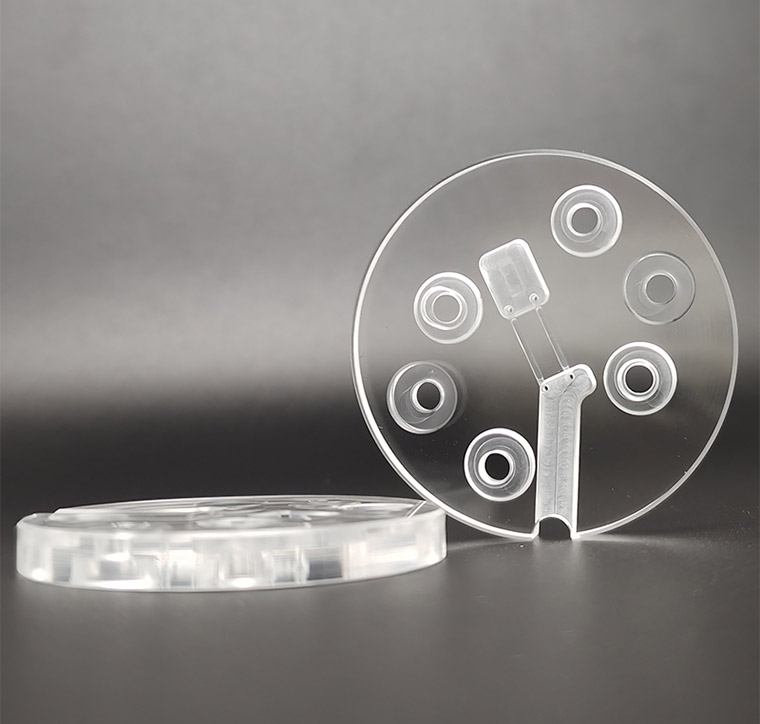
Using high-speed, rigid multi-axis milling setups, we produce complex structural geometries, O-ring grooves, stepped holes, and pocket arrays out of thick cast acrylic block. High feed optimization keeps surfaces clean and flat.

الخراطة الدقيقة باستخدام الحاسب الآلي (CNC)

Our lathes deliver outstanding concentricity and ultra-smooth finishes for cylindrical acrylic components. We regularly machine custom acrylic light guides, sight glasses, medical tubes, and decorative knobs with clean, accurate internal and external threading.

Industries & Applications for Precision Machined Acrylic Components

الصناعة المكونات الرئيسية
Medical Diagnostics & Life Sciences Microfluidic chips, transparent analytical manifolds, test-tube racks, diagnostic device housings, medical incubator windows.
Optical & Lighting Technology Custom lenses, prismatic light guides, light diffusers, optical housings, sight glasses, underwater camera enclosures.
Aerospace & Specialized Vehicles Pressure cabin windows, observation domes, vehicle instrumentation covers, protective internal shield plates.
Semiconductor & Fluid Handling Level indicator blocks, customized transparent valve bodies, chemical flow indicators, laboratory fluid isolation components.

Design Guidance for Machined Acrylic Components

  • Maintain a minimum corner radius of at least 1.0 mm inside all pockets; sharp 90-degree internal corners create severe stress concentrations that cause acrylic to crack over time.
  • Keep wall thicknesses above 1.5 mm to prevent material flexing, fracturing, or blowing out under high cutting pressures.
  • Avoid deep, narrow blind holes; chip evacuation is difficult in deep cavities, increasing the risk of frictional melting and tool binding.
  • Always prefer coarse threads over ultra-fine threads. Consider using threaded brass or stainless steel inserts if the component requires frequent disassembly.
  • Clearly indicate on your blueprint which surfaces must remain optically clear (transparent) vs. which surfaces can remain as-machined (translucent/frosted).

Specialized Polishing & Post-Processing Options

CNC machining inherently leaves a frosted texture. We offer several premium surface finishing techniques to achieve varying levels of transparency and scratch resistance:

  • As-Machined (Translucent): Matte, frosted appearance with faint tool path marks; suitable for non-visible internal fluid blocks.
  • Diamond Edge Polishing: Utilizes precision rotating diamond tools on our CNC equipment to achieve an instantly clear, highly consistent edge finish on straight profiles.
  • Vapor Polishing: Uses a specialized chemical gas (Weld-On solvent vapor) to microscopically reflow the outermost surface molecules of the acrylic. Perfect for restoring full transparency inside deep internal cavities, cross-drilled holes, and complex manifold channels.
  • Flame Polishing / Manual Buffing: A skilled technician applies controlled thermal energy or ultra-fine abrasive wheels to achieve a beautiful, high-gloss display-grade aesthetic on external surfaces.
  • Scratch-Resistant Anti-Reflective Coating: Optional hard-coat dip or spray application to improve the surface hardness and longevity of exposed optical components.

Quality Control & Precision Calibration

Acrylic expands under elevated temperatures. AluCarbon Tech isolates environmental factors by machining and inspecting parts within climate-stabilized metrology cleanrooms:


  • Non-contact vision inspection systems and low-force coordinate measuring machines (CMM) to prevent scratching delicate transparent surfaces during inspection.
  • Strict batch testing for internal material stresses using specialized polariscopes to avoid post-delivery stress cracking.
  • Regular profilometer tracking to verify specified micro-inch surface roughness before and after polishing.
قدرات التحمل: Standard: ±0.10 mm | Tight / Engineered: ±0.05 mm | Specialized Critical Fits: Up to ±0.02 mm under specialized processing controls.

اعتبارات التكلفة ومدة التنفيذ

  • Material Type: Cast Acrylic costs more than extruded material, but it significantly reduces machining scrap and allows for premium clarity, lowering overall project costs.
  • Polishing Requirements: Achieving full optical clarity requires multi-stage post-processing. Specifying clarity only where functionally required keeps your budget optimized.
  • Tooling Complexity: Deep pockets and tight internal radii require slow, multi-pass toolpaths and delicate micro-tooling, which increases machining cycle times.
  • Typical Lead Time: 2-3 weeks for standard custom components. Optional rapid prototyping delivery (10-14 days) is available for urgent product developments and engineering deadlines.

Why Choose AluCarbon Tech for Acrylic CNC Machining

  • Decade-long technical expertise in handling both Cast Acrylic (optimized for machining) and Extruded Acrylic.
  • Specialized diamond-tipped (PCD) and polished carbide tools to achieve exceptionally smooth, low-friction cuts.
  • State-of-the-art multi-axis CNC milling and turning centers calibrated specifically to mitigate vibration and eliminate material cracking.
  • Strict standard production tolerances within ±0.1 mm, with the capability to hold ±0.05 mm for specialized engineering constraints.
  • Advanced in-house surface polishing capabilities, including diamond edge polishing, vapor polishing, and manual buffing for flawless clarity.
  • ISO 9001:2015 certified production environment ensuring comprehensive quality checks and raw material batch verification.
  • Global logistics execution with streamlined customs clearing and highly competitive factory-direct manufacturing costs.

الأسئلة الشائعة (FAQ)

Q: How does AluCarbon Tech prevent acrylic parts from cracking during the CNC process?
A: Cracking is caused by tool friction and sudden mechanical impacts. We prevent this by exclusively utilizing razor-sharp, mirror-polished single or double-flute carbide tools, executing smooth, optimized ramp-in lead codes, and enforcing rigorous chip-flushing protocols to avoid thermal buildup.
Q: Can a machined acrylic part achieve 100% optical clarity like glass?
A: Yes. While raw machining leaves a translucent, frosted appearance, we can fully restore the acrylic to a glass-like, 100% transparent state through our professional post-processing options, including advanced vapor polishing, diamond tool edge dressing, and manual micro-abrasive buffing.
Q: What is the main operational difference between vapor polishing and flame polishing?
A: Flame polishing applies high heat to melt external surfaces, which is excellent for external gloss but cannot reach internal channels. Vapor polishing utilizes a specialized solvent gas to carefully reflow molecules inside complex internal intersections, cross-drilled fluidic paths, and blind holes, making it the premier choice for complex engineering parts.
Q: Is Acrylic suitable for high-stress or high-temperature engineering environments?
A: Acrylic is rigid and strong but has a continuous service temperature limit of around 70°C to 80°C. For applications exposed to higher temperatures or harsh chemical solvents, engineering plastics such as Polycarbonate (PC) or cyclic olefin copolymers (COC) may be recommended by our team.
Q: What is your minimum order quantity (MOQ) for custom acrylic parts?
A: We maintain a flexible zero MOQ framework. We support your development journey from a single transparent prototype up to scalable production batches exceeding 1,000+ custom parts.
اتصل بنا

أرسل رسالتك